Invest in the Future: Why supporting High Tech Futures matters
"A life-changing experience.. I found my dream job"
Student, Leytonstone School, attended a Future Biotechnologist career carousel
The UK's life sciences, technology and high tech engineering sectors are among the most dynamic and economically vital in the world. From surgical robotics and AI-powered diagnostics to semiconductors, green energy and aerospace, they are shaping how we live, work and tackle the defining challenges of the century.
But there is a serious and growing problem: the talent pipeline that feeds these sectors is too narrow, too homogenous, and too dependent on a single route in. The demand for skilled workers is set to intensify. The IMF has identified an "urgent need to upskill the UK workforce" and recommends concrete measures to "encourage students and young workers to join and excel in STEM" (1).
High Tech Futures believes that the next great leap in science and technology could come from a student sitting in a classroom today, waiting for the spark of inspiration. Our mission is to provide that spark.
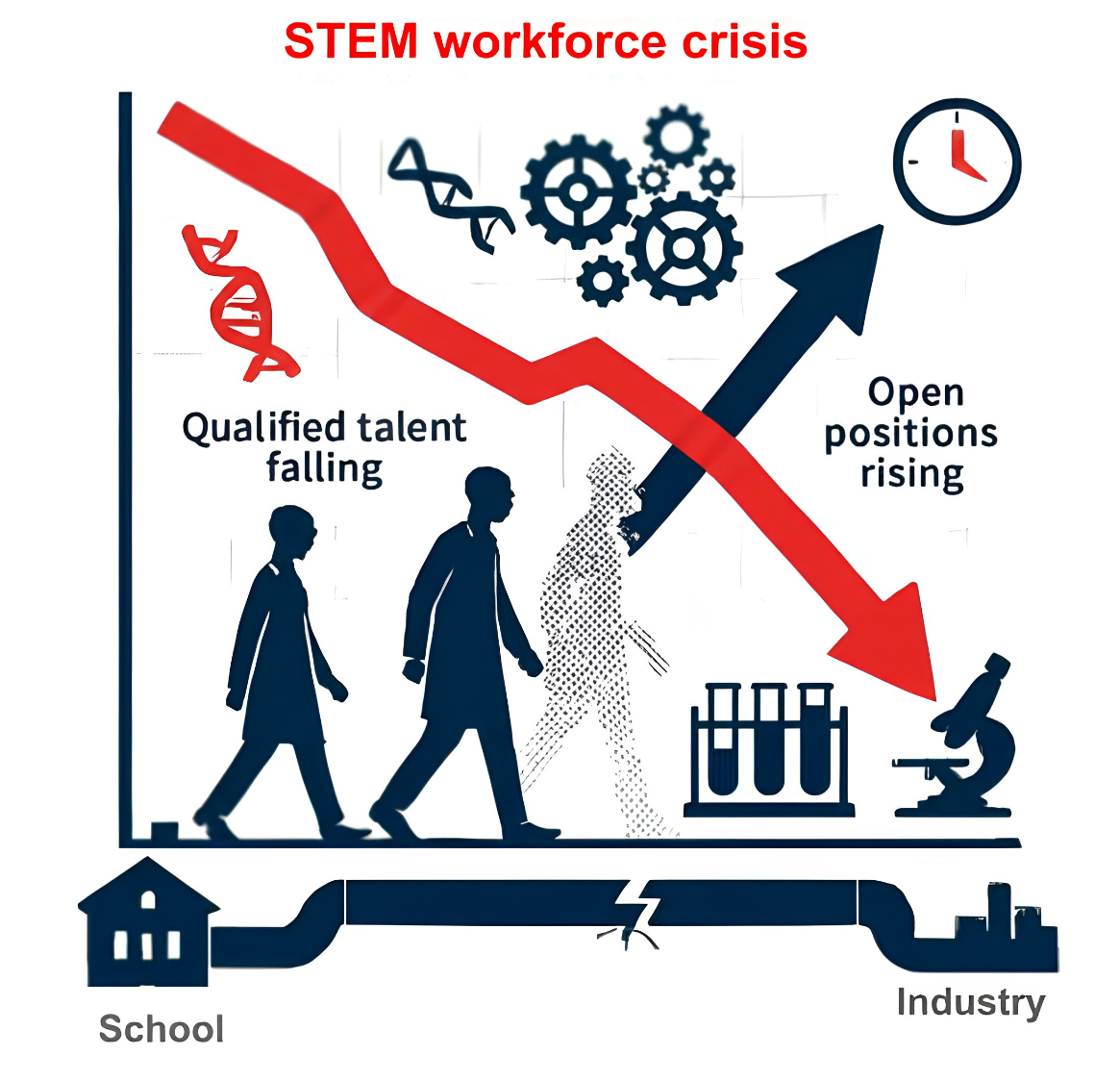
The talent gap is real
Demand for skilled scientists, technologists and engineers in the UK consistently outstrips supply. In 2025 nearly half (49%) of engineering and technology companies in the UK reported 'recruitment difficulties stemming from skills shortages, costing the economy around £1.5 billion annually' (2). Approximately 65% of life science employers also reported difficulties in recruiting suitable candidates, with average time-to-fill for roles extending to 78 days due to competition and limited niche talent pools (3).
This is not just a human resources challenge; it is a direct risk to innovation, productivity, and economic growth. Recruitment difficulties are costing the UK economy tens of billions of pounds annually and threatens to stall growth in key sectors. Shortages are particularly acute in high-growth engineering and technology sectors.
Sector-specific shortages
The STEM talent pipeline is uneven, with students from disadvantaged backgrounds significantly less likely to progress to post-16 STEM pathways. Those eligible for free school meals are around 44% less likely to do so than their more advantaged peers.(6) Progression to STEM qualifications varies dramatically by background: among the groups least likely to progress are female, disadvantaged pupils from White British backgrounds and from mixed White/Black Caribbean backgrounds (5).
The reason for the uneven STEM pipeline is not about potential, but about access and aspiration.
Digital skills
The UK's digital talent gap has a critical bottleneck, with the scarcity of skills being most prominent in areas like AI, automation, data science, cybersecurity and software engineering. In England 36% of vacancies in AI-relevant occupations are caused by digital skills shortages (4).
The problem is compounded by the lack of digital literacy among the working-age population. A UK government review published in 2024, found that “7.5 million people, or 18% of UK adults, lacked the essential digital skills that are needed for the workplace.” It estimated that the digital skills gap “cost the UK economy £63 billion per year” (5).
Engineering
The shortfall in engineering talent is acute and well-documented. The UK needs 124,000 new engineers and technicians each year to meet demand, but current projections show an annual shortfall of 37,000-59,000 (6). If anything the shortfall is increasing. Two surveys carried out in 2021 and 2025 with employers of engineering and technology staff indicated that the proportion struggling to recruit people with particular skills had increased from 50% to 76%. In 2025 such employers reported "technical/specialist sustainability skills (such as how to decarbonise)" were the most difficult to find. This was cited by 30%. Closely following were "'soft' skills, such as complex problem-solving (27%), innovative thinking (27%), agile mindsets (26%), and whole systems thinking (25%).” Specialist digital skills/knowledge skills were also cited by 23% of the survey respondents.(7).
Technicians
The UK is estimated to have 2 million technicians. These are skilled professionals with practical expertise and technical knowledge who generally have not attended university. Performing a wide range of roles, such people are vital to the future of the UK economy. Their practical expertise is "indispensable not only in established industries - such as manufacturing, construction and defence - but also in fast-growing fields like clean energy, life sciences and digital technology" (8).
Despite their importance, the UK is facing an acute technician shortage. More than one in three technician roles central to the UK's industrial strategy face severe shortages. Multiple factors contribute to the problem. It includes an ageing workforce, changes to immigration rules, underinvestment in training and education and structural barriers to women technicians in areas like advanced manufacturing and systems-oriented, physically intensive and higher paid sectors (8, 9).
Life Sciences and Biotechnology
Contributing £36.9 billion to the UK economy every year, the UK life science sector is at the heart of global innovation. Between 2016-17 and 2021-22 employment in the sector grew 16% and today the industry directly employs 270,900 people across 5,800 businesses (10).
To maintain its leading position the industry is estimated to need as many as 145,000 skilled employees by 2035. With approximately 16% of the life science workforce expected to retire over the next decade, an additional 75,000 additional employees will be needed to replace those who leave. This is in addition to 70,000 new jobs that will be needed to meet the sector's expansion into data-driven discovery and AI-driven applications (10).
The life sciences not only faces a major recruitment challenge in the future. Recruitment is already at a critical point. A Skills England report published in June 2026 indicates 75% of life sciences “priority occupations in critical or elevated demand across the UK economy, indicating widespread and acute recruitment challenges”. It highlights gaps across specialist science and research, digital and data skills, medicines manufacturing, and translation and commercialisation (11).
The Diversity Deficit: Talent Left Untapped
The pipeline problem is compounded by a serious lack of diversity. UK government figures indicate that 65% of the STEM workforce are white men, and proportionally, white women are less likely to be STEM workers than ethnic minority women. Women account for only 24% of the STEM workforce in the UK, and just 8% of the STEM workforce comes from Black, Asian and minority ethnic backgrounds (12).
A House of Commons Science and Technology Committee inquiry found that women, people from certain ethnic backgrounds, people with disabilities, those from disadvantaged socio-economic backgrounds and those who identify as LGBTQ+ are all underrepresented in STEM education, training and employment and that this has been the case for over a decade with limited improvement. The same inquiry noted that just 25% of disadvantaged pupils achieve a good pass in GCSE maths, and in 2019 only 7% of all students taking A-level Further Mathematics were classified as disadvantaged, compared with 12% of all A-level students and around 30% of the state school population as a whole (13).
A Vision for a More Inclusive Future
Bright, curious young people from disadvantaged backgrounds and minority communities are being left out of the conversation - not because they lack potential, but because no one has yet shown them the door. High Tech Futures exists to change that.
By directly connecting students in state-funded, non-selective schools with the cutting edge of UK innovation, High Tech Futures is not just inspiring the next generation, it is actively building it.
High Tech Futures works directly with state-funded, non-selective schools and colleges - the institutions serving the students least likely to encounter cutting-edge science and technology through existing channels. Through free carousel sessions, challenges, seminars and skills boot camps, it connects students with professionals working at the frontier of these fields.
The activities offered by High Tech Futures provide active engagement. Students work on real-world problems, hearing from people who look like them and come from communities like theirs. They discover pathways into remarkable careers that they simply did not know existed.
Why sponsor High Tech Futures?
The UK stands at a critical juncture. Our ambition to become a global leader in cutting-edge sectors like AI, biotechnology, and advanced engineering is threatened by a persistent and growing skills gap.
High Tech Futures offers a powerful solution by directly addressing the root causes of this crisis. By becoming a sponsor, your organisation can play a pivotal role in building the diverse, skilled talent pipeline the UK urgently needs.
Five reasons why sponsorship is a strategic investment:
1. Expanding horizons
Biotechnology, technology and high tech engineering are no longer separate fields. The most transformative developments - brain-machine interfaces, smart materials, AI-driven drug discovery, autonomous systems - are happening precisely where these disciplines converge.
By introducing students to all three sectors together, High Tech Futures gives them a richer, more accurate picture of where the opportunities lie, and encourages the kind of cross-disciplinary thinking that the next generation of innovators will need.
2. Democratising Opportunity
The most exciting careers in biotechnology, artificial intelligence, and advanced engineering are often the least visible to young people from underrepresented backgrounds. High Tech Futures breaks down these barriers by bringing the sector directly into the classroom.
Our free programmes, focused on areas of high deprivation, ensure that a student's postcode does not determine their potential to become a future leader in these high-growth industries.
One of the most significant barriers to a diverse talent pipeline is the assumption - held by students, parents and sometimes teachers - that a conventional science degree is the only way in. High Tech Futures deliberately highlights apprenticeships, technical qualifications and alternative entry routes, making clear that there are many roads into these sectors and that students do not have to follow a single prescribed path to get there.
3. Inspiring Through Real-World Connection: "You can't be what you can't see"
Our carousel sessions, challenges, and mentorship programmes connect students directly with the people who are building the future today. Hearing the personal journeys of engineers, technologists, and scientists, particularly those from similar backgrounds, is transformative. It makes the impossible seem achievable and demonstrates that a career in high tech is for them.
By focusing on practical skills, team working, and creative problem-solving, we show that talent and determination are as valuable as a specific academic qualification.
4. Equipping Students with the Skills of Tomorrow
Our challenges, like the UK Schools AI Challenge and TechInnovators Challenge, are not abstract exercises. They are designed to build real-world skills - coding, data literacy, ethical reasoning, and communication - that are critical for the future workforce. By engaging with the ethical dimensions of AI or the practicalities of a clinical trial, students develop a deeper understanding that goes beyond the technology itself.
5. Fueling the UK's Innovation Engine
The most successful economies are built on diverse talent pools that bring different perspectives to complex problems. By nurturing a generation of innovators from all communities, High Tech Futures is not just a social good; it's an economic necessity. We are creating a resilient, homegrown talent pipeline that will keep the UK at the forefront of global science, technology, and engineering for decades to come.
Investment that pays back many times over
Early, meaningful exposure to science and technology careers changes trajectories. It builds aspiration, opens minds and - critically - keeps options open at exactly the moment when young people are making decisions that will shape the rest of their lives. Providing these experiences free of charge to schools removes the financial barriers that would otherwise determine who benefits and who does not.
The UK has the research base, the institutions and the companies to remain a world leader in science and technology for generations to come. What it needs is the full depth of its human talent. High Tech Futures is helping to unlock it.
References
- IMF Selected Issues Paper. European Department (July 2024) 'Upskilling the UK Workforce'
- PWE (12 Jan 2026) 'Addressing skills gaps in UK pipeline operations'.
- Cambridge Network (2026) 'Navigating the UK life sciences talent landscape in 2025'.
- Skills England (June 2025) Digital Technologies.
- UK Parliament (12 April 2024) Research Briefing: Digital skills and careers.
- Institution of Mechanical Engineers (22 Jan 2025) 'Engineering 'could face NHS-like workforce crisis' without skills focus in Industrial Strategy'.
- The Institution of Engineering and Technology (April 2025) 'UK Engineering and Technology Skills'.
- H Carr, M Mamertino (Nov 2025) 'Mind the Technician Gap: Fixing the UK's Hidden Labour Crisis', The Burning Glass Institute.
- J French (16 Dec 2025) Mind the technician gap: why Britain's industrial ambitions depend on skills we are failing to develop.
- Future Group (2025) 'Life Sciences 2035: Developing the Skills for Future Growth'.
- Skills England (1 June 2026) 'Sector Skills Needs Assessment: Life Sciences'.
- UK Parliament Committee: Diversity and inclusion in STEM.
- UK House of Commons Report, Improving educational outcomes for disadvantaged children, Thirteenth Report of Session 2024-25.